
MBTI
ENTJ function stack
The ENTJ stack is often described as Te, Ni, Se, and Fi. Here is how direction, structure, the live scene, and personal value interact.
What this is
For people who recognize ENTJ, the Commander, attention often starts by organizing the outside world, aims that organization at a converging future, reads the live situation to push, and consults a personal value later than the plan.
The fourth function is not a missing conscience. It is a voice that may not get the microphone until something already feels off. Growth is handing it the microphone sooner.
The four functions
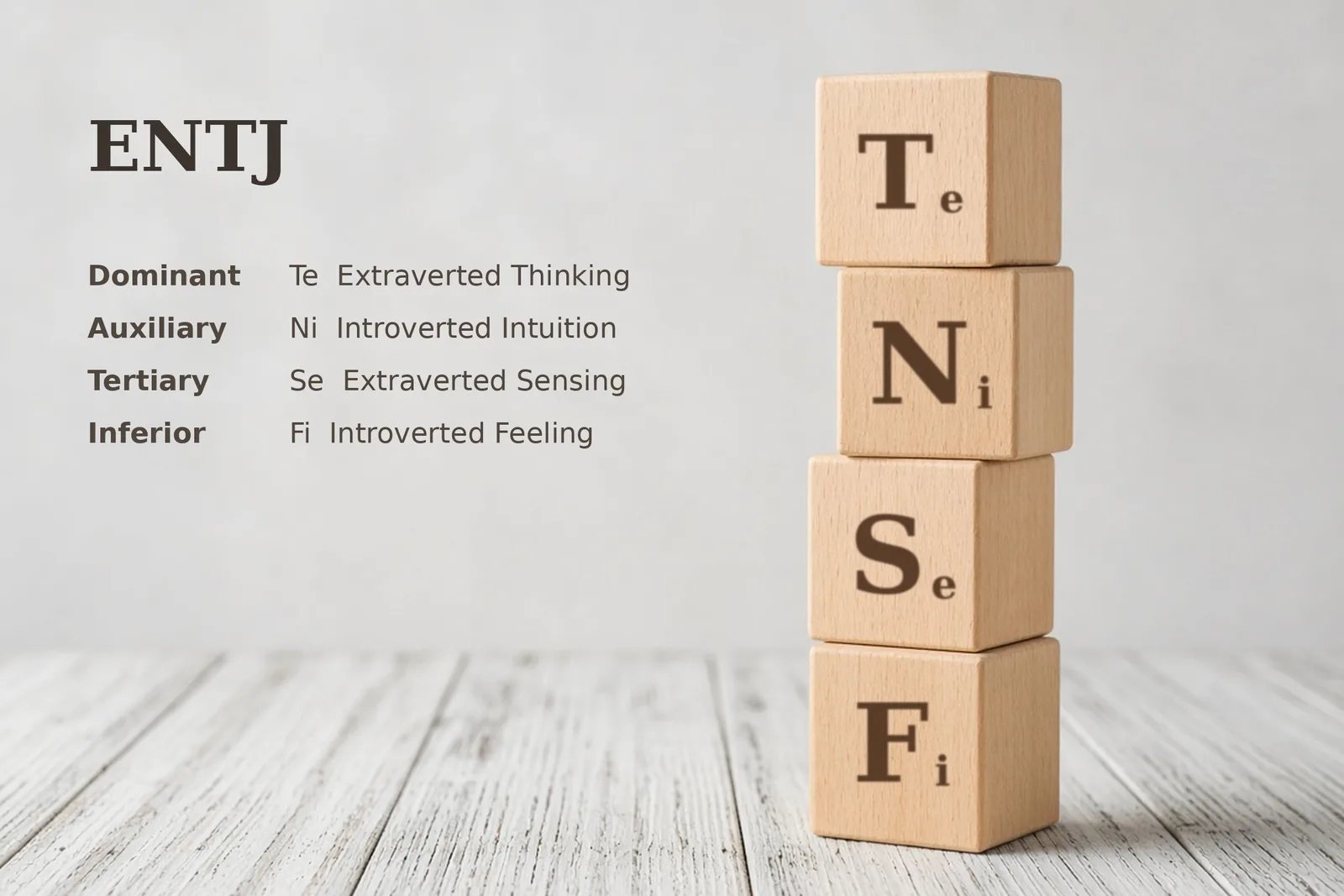
Extraverted Thinking (Te) in the lead wants the shared world to have owners, measures, and a sequence. Ambiguity that nobody is resolving feels like a leak.
Introverted Intuition (Ni) as the second function points Te at a future worth the effort. Without it, organization becomes busyness. With it, the plan has a point on the horizon.
Extraverted Sensing (Se) in the third position notices what the room, the market, and the prototype are doing right now. It can make the leader tactically sharp, or merely impatient.
Introverted Feeling (Fi) in the fourth position asks whether the goal is actually yours and whether people are being used up. Under strain it can erupt as a personal absolute after a long stretch of pure efficiency.
Strengths
Te and Ni together can turn a vague ambition into a campaign. Se keeps the campaign in contact with this week. Fi, included early, stops the campaign from succeeding at a cost you will not respect later. That combination is why some builders can both aim and ship.
Blind spots
Te will organize people who did not agree to be organized. Ni can treat dissent as noise. Se can push for visible motion when the wiser move is to wait. Fi, starved, returns as burnout, contempt, or a sudden claim that nobody else has values.
At work and while building
State the Ni aim and the Te constraint, then ask what Se is seeing that the plan has not absorbed. Put a Fi check on the decision record: who is harmed, and is this still a goal you claim in private? Leave a method for the team to own so your drive is not the only engine.
In relationships
People may feel managed by Te long before they feel chosen by Fi. Say what you value about them apart from their usefulness. In conflict, do not skip to the remediation plan until they agree you understood the human part. Se can help here: stay in the actual conversation instead of retreating into the future fix.
Personal growth
Let Fi define a limit Te is not allowed to optimize away: sleep, a relationship, a line you will not cross for growth. A commander with a conscience people can hear is easier to follow, including for yourself.
Ways to practice
- Write the goal, the metric, and one value the metric is not allowed to violate.
- In the next push for speed, ask what the room is showing that your timeline ignores.
- Tell someone what you appreciate about them that does not help the project.
- Block an hour with no outcome. Notice which ambition was actually anxiety.