
MBTI
INTP function stack
The INTP stack is often described as Ti, Ne, Si, and Fe. Here is how precision, possibility, memory, and people tend to interact.
What this is
For people who recognize INTP, the Logician, attention often starts with an inner standard of coherence, then opens outward to possibilities, checks them against what has already been tried, and only later deals explicitly with the social field.
The order is a lens. A person can lead with careful logic and still be warm, late, funny, or deeply invested in someone. The stack describes habits of attention, not a personality cage.
The four functions
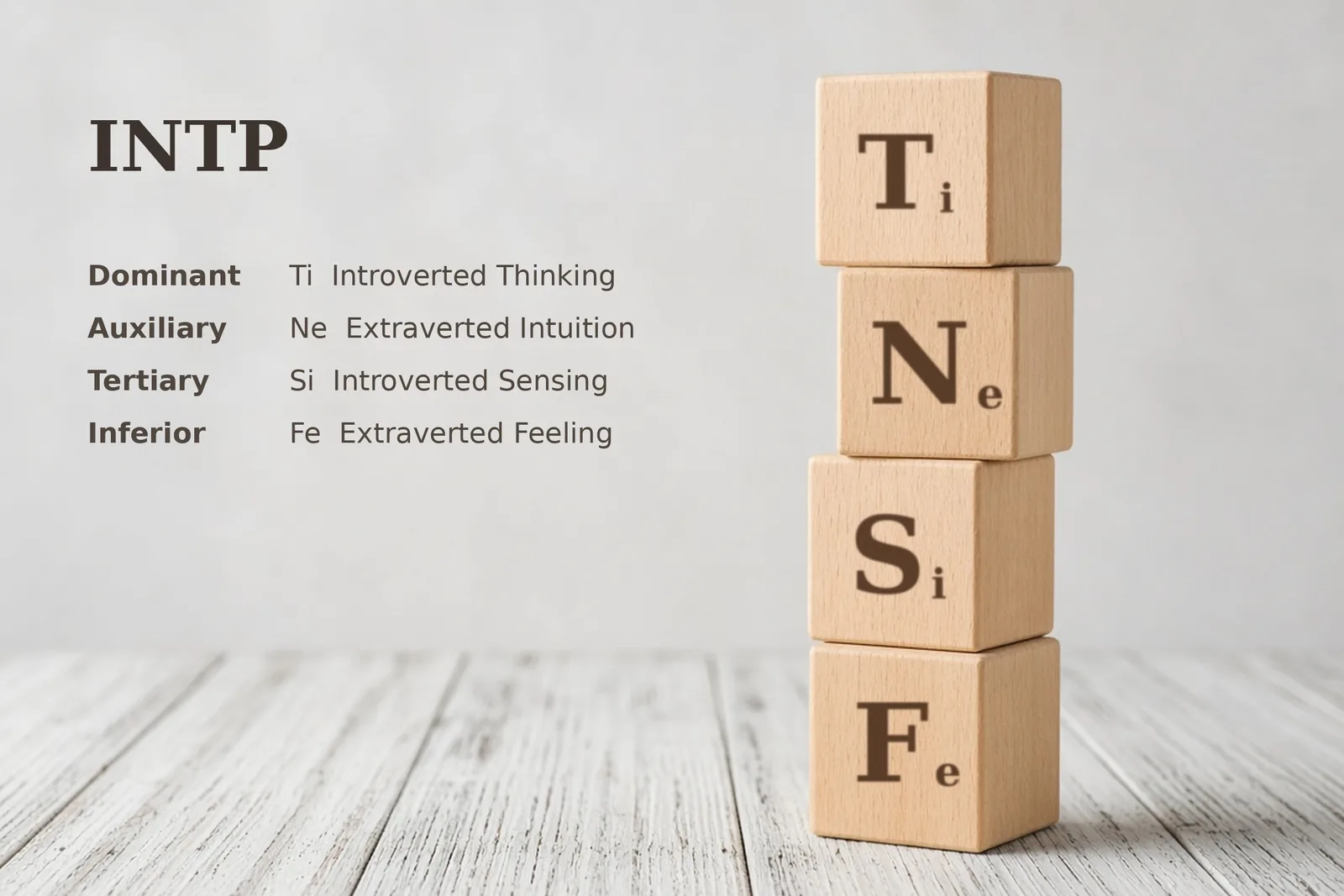
Introverted Thinking (Ti) in the lead wants the explanation to hold together on the inside. Definitions matter. A popular idea that does not parse will not feel true just because it is popular.
Extraverted Intuition (Ne) as the second function supplies the counterexamples, adjacent models, and odd connections that keep Ti from becoming a closed dogma. It is why the analysis stays curious.
Introverted Sensing (Si) in the third position is a private archive: what this kind of bug did last time, how a method felt, which detail keeps recurring. It can steady Ne or trap it in an old frame.
Extraverted Feeling (Fe) in the fourth position is the live impact on people. It can be awkward, surprisingly tender, or postponed until a relationship is already strained.
Strengths
Ti plus Ne is a strong research pair. You can take a system apart and imagine the version that would actually be consistent. Si adds caution that is earned rather than fashionable. When Fe is included on purpose, the precise person becomes someone others can think with, not only be corrected by.
Blind spots
Ne can keep Ti in permanent beta. Si may insist the last careful version is safer than a shippable one. Fe, left until the end, means people experience the critique without the regard. A correct model that isolates you is an incomplete model of the problem, if the problem involves humans.
At work and while building
Give Ti a question worth parsing and Ne a boundary: two alternate designs, then a choice. Write the Si lesson from the last attempt so you do not rediscover it by accident. Put Fe on the checklist as a user, a teammate, or a sentence of context, not as a costume you wear at the end.
In relationships
Someone can feel your loyalty as time spent on their problem and still not feel chosen, because Fe was implied. Say the care in words. In conflict, pause the definitional debate long enough to ask what they need to feel considered. Then return to the logic. Both parts belong to the repair.
Personal growth
Practice publishing a coherent draft before it is elegant. Let people and past experience edit it. Fe grows when it is used in ordinary weeks, not saved for an apology.
Ways to practice
- Time-box one analysis. At the end, write the decision you will use if no cleaner model appears.
- Tell a collaborator which part of their idea holds and which part you are still testing.
- Note one lesson from a previous project before you redesign the same layer.
- Send one specific appreciation that is not a critique in disguise.